An exterior perimeter barrier addresses American cockroaches (commonly termed palmetto bugs) at their breeding source rather than scattering chemicals inside family living spaces. Periplaneta americana breeds outdoors…
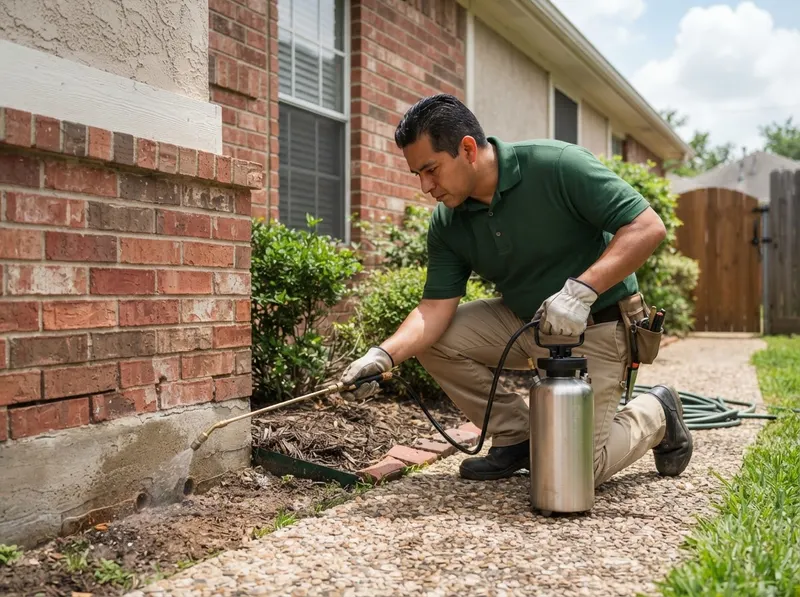
An exterior perimeter barrier addresses American cockroaches (commonly termed palmetto bugs) at their breeding source rather than scattering chemicals inside family living spaces. Periplaneta americana breeds outdoors in damp pine bark, storm drainage easements, and compost beds, growing up to 2.1 inches in length. In neighborhoods like Memorial, River Oaks, and The Heights, mature oak canopies and heavy mulch retain soil moisture that accelerates egg-case development. Standard indoor aerosol sprays fail because they address single foragers instead of eliminating the population pressure against exterior walls. A dedicated perimeter barrier applies micro-encapsulated insect growth regulators and botanical repellent zones that adhere to concrete slabs, brick weep holes, and sub-siding gaps without leaving harsh chemical odors indoors. This method protects indoor environments where infants and household pets spend time, limiting treatment materials strictly to exterior structural perimeters.
The application process uses a multi-tiered defense strategy tailored to Harris County infrastructure. Technicians treat a continuous 10-foot horizontal band out from the foundation edge, combined with a 3-foot vertical ascent up the exterior wall masonry. Sub-surface granular formulations are placed into mulch and ground cover where liquid sprays degrade under midday sun exposure. For pier-and-beam properties common in Montrose, Oak Forest, and West University Place, crawlspace vents and support pillars receive localized hydrophobic applications that resist high humidity and groundwater evaporation. In high-water-table areas near Buffalo Bayou Park and Clear Lake, moisture-resistant synthetic pyrethroids prevent water wash-off during heavy afternoon rain storms. Plumbing penetrations, air conditioning chase lines, and electrical conduits are treated with structural drying dusts that desiccate insect exoskeletons without washing away into municipal storm drains.
Property size and foundation architecture dictate the required barrier protocol. Homeowners choose between a standalone barrier installation or an integrated exclusion package that incorporates physical mesh over brick weep vents. A standard chemical barrier requires reapplication every 60 to 90 days to maintain active residual levels under Houston's average 75% relative humidity and intense ultraviolet exposure. The physical mesh upgrade provides non-chemical exclusion along expansion joints, but requires a higher initial investment. Perimeter barriers do not require ongoing auto-renewal contracts, functioning as on-demand, seasonal interventions during late spring moisture surges or post-flood dispersals near Kingwood and Meyerland waterways. Trade-offs involve property upkeep: thick ground ivy or wood mulch stacked above the foundation brick line can bridge over chemical barriers, requiring 6 inches of foundation clearance to retain maximum protective efficiency.
Every job gets a firm, written price after a free on-site visit.
Tell us about your american roach perimeter barrier job in Houston and we'll send a clear, written quote, usually the same day.
 (346) 776-1611