Subterranean termites require direct contact with soil moisture to survive, making Houston's gumbo clay and alluvial bayou deposits an active habitat across Harris County. Homes in The Heights, Montrose, and Oak Forest…
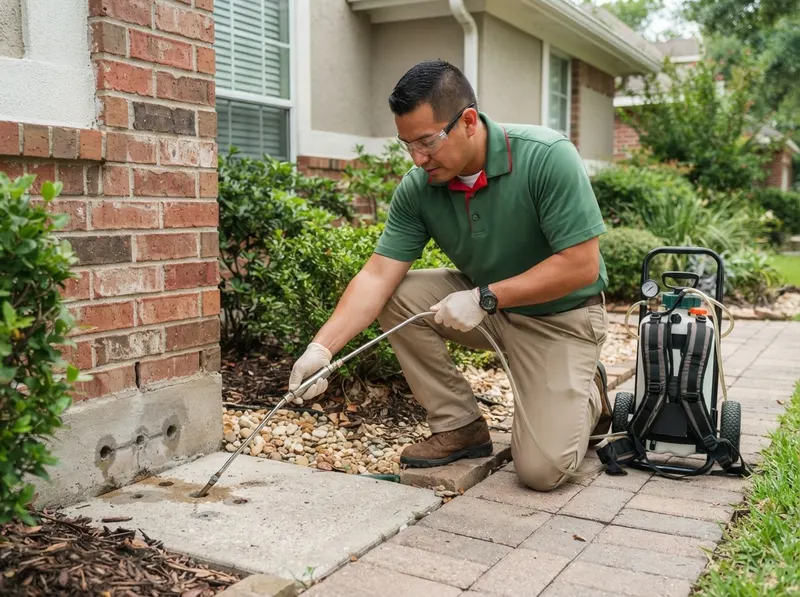
Subterranean termites require direct contact with soil moisture to survive, making Houston's gumbo clay and alluvial bayou deposits an active habitat across Harris County. Homes in The Heights, Montrose, and Oak Forest featuring pier-and-beam foundations require crawlspace soil treatments along internal support posts, whereas modern concrete slab constructions in Memorial, River Oaks, and Kingwood demand perimeter trenching and localized sub-slab drilling near plumbing penetrations. Native subterranean species construct mud tubes across concrete footings to enter sill plates, while invasive Formosan subterranean termites establish secondary aerial carton nests inside walls if structural leaks provide sustained dampness.
Eradication relies on continuous chemical barriers or slow-acting insect growth regulator baits. Liquid non-repellent barriers create an undetectable treated zone in the exterior soil 4 to 6 inches wide and 6 inches deep around the foundation perimeter. Foraging worker termites pass through the agent, grooming and transferring the compound back to the subterranean colony over 30 to 90 days. For properties situated directly adjacent to waterways like Buffalo Bayou Park or residential areas in Clear Lake and West University Place with high water tables, external bait stations placed every 10 to 15 linear feet offer targeted colony interception without deep soil trenching. The trade-off between approaches centers on speed versus continuous monitoring: liquid barriers provide immediate containment lasting 5 to 10 years, whereas bait systems require regular cartridge inspections every 60 to 90 days to verify colony suppression.
Structural moisture mitigation directly determines long-term success against repeat subterranean swarms during humid spring flights. Properties in low-lying sections of Meyerland benefit from addressing perimeter downspouts, HVAC condensation lines, and wood-to-ground contact points along decking or siding. Licensed technicians evaluate structural linear footage, plumbing access traps, and expansion joints during the preliminary assessment to confirm an exact treatment blueprint.
Every job gets a firm, written price after a free on-site visit.
Tell us about your subterranean termite treatment job in Houston and we'll send a clear, written quote, usually the same day.
 (346) 776-1611