Red imported fire ants thrive in the dense clay loam and high humidity of the upper Texas Gulf Coast, often establishing subterranean networks that extend four to six feet beneath turf. In neighborhoods like West…
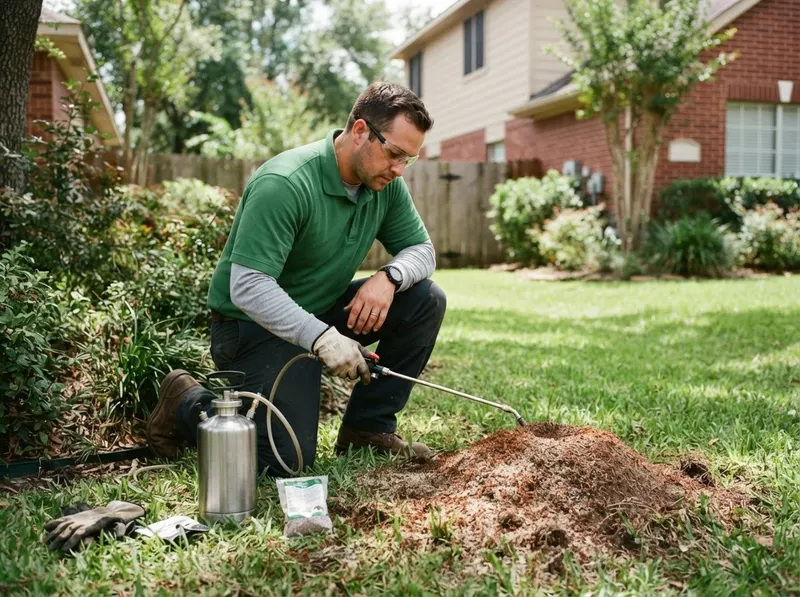
Red imported fire ants thrive in the dense clay loam and high humidity of the upper Texas Gulf Coast, often establishing subterranean networks that extend four to six feet beneath turf. In neighborhoods like West University Place, Meyerland, and Oak Forest, flood cycles along local bayous drive foraging workers upward, creating dozens of visible surface mounds overnight along sidewalk cracks and foundational slabs. Surface-level contact dusts purchased at retail outlets only kill the top layer of sterile workers; this triggers the colony to split into multiple satellite mounds through a survival process called budding. Professional eradication breaks this cycle by distributing granular baits containing abamectin or hydramethylnon across the turf. Foraging worker ants carry these food particles down into the central nest chambers to feed the reproductive queens, neutralizing the reproductive cycle within 7 to 21 days.
Selecting whole-yard eradication over localized mound spot-treatments depends on property density and ant pressure. Individual mound drenching suits isolated mounds appearing after light rains, but it leaves hidden subterranean nests intact along fence lines. Whole-yard broadcast applications treat the entire property footprint to eliminate invisible, developing colonies before they erupt across open grass. The primary trade-off involves timing: localized contact treatments stop surface movement within 2 hours but fail to eliminate underground nests, whereas biological baiting protocols require 10 to 14 days to fully circulate through the nest architecture, delivering complete colony collapse that lasts several months.
Properties bordering natural riparian corridors, such as Memorial and River Oaks near Buffalo Bayou, or Clear Lake and Kingwood near forested greenbelts, experience aggressive re-infestation pressure from neighboring untreated acreage. 1. Technicians survey turf boundaries, garden beds, and air conditioning drip lines to map active mound clusters. 2. A calibrated broadcast distributor lays low-toxicity bait granules across open turf areas during dry morning foraging periods. 3. Active mounds receive localized drenches using botanical or low-odor liquid solutions to collapse immediate safety hazards near walkways, pet runs, and play spaces. 4. A protective barrier is applied along structural perimeters to prevent displaced ants from migrating into indoor wall voids.
Every job gets a firm, written price after a free on-site visit.
Tell us about your fire ant yard eradication job in Houston and we'll send a clear, written quote, usually the same day.
 (346) 776-1611